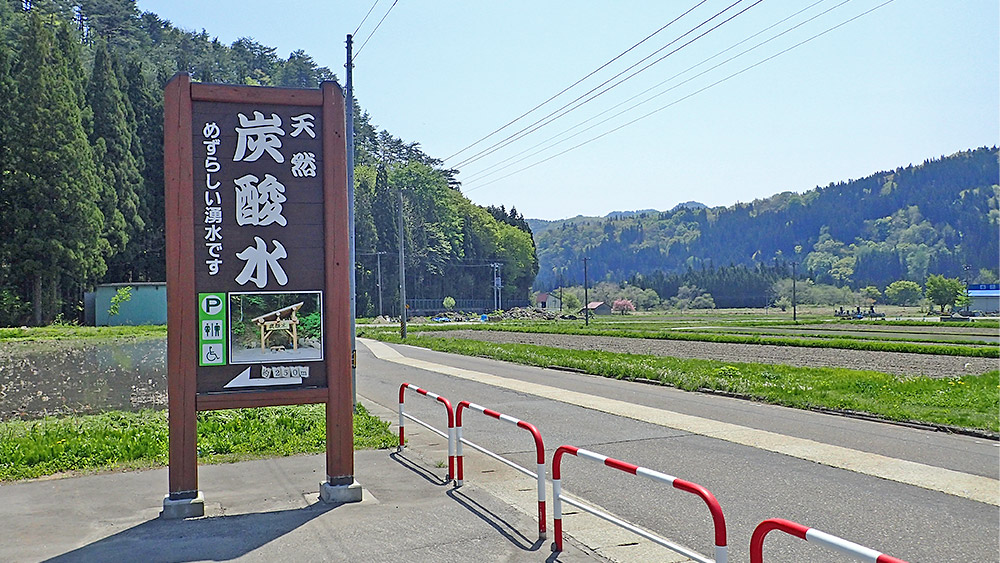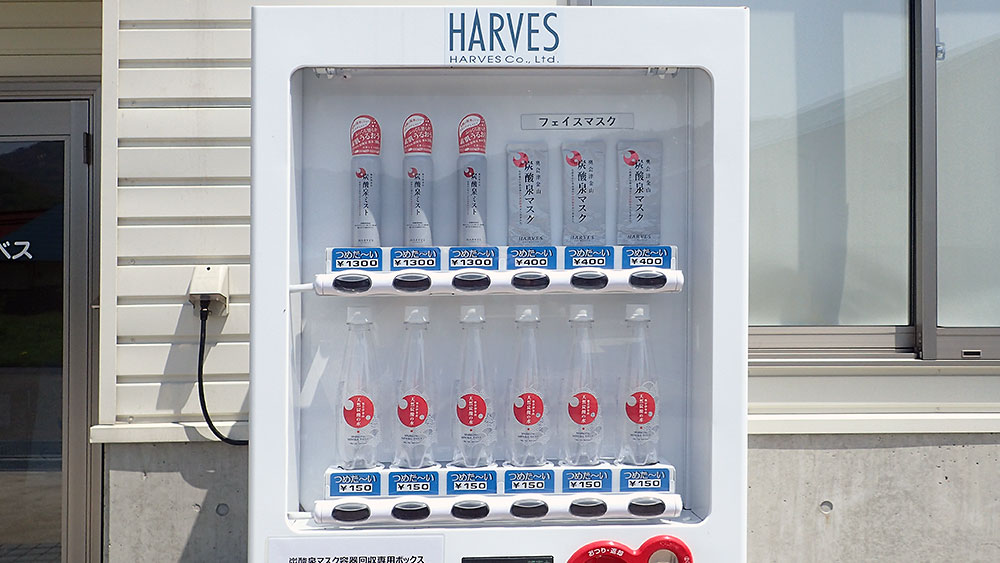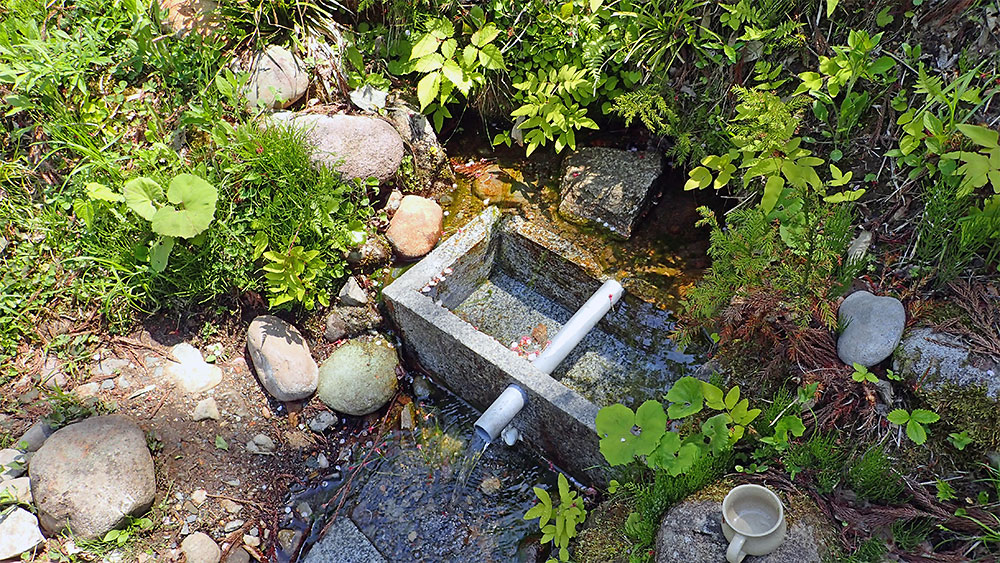
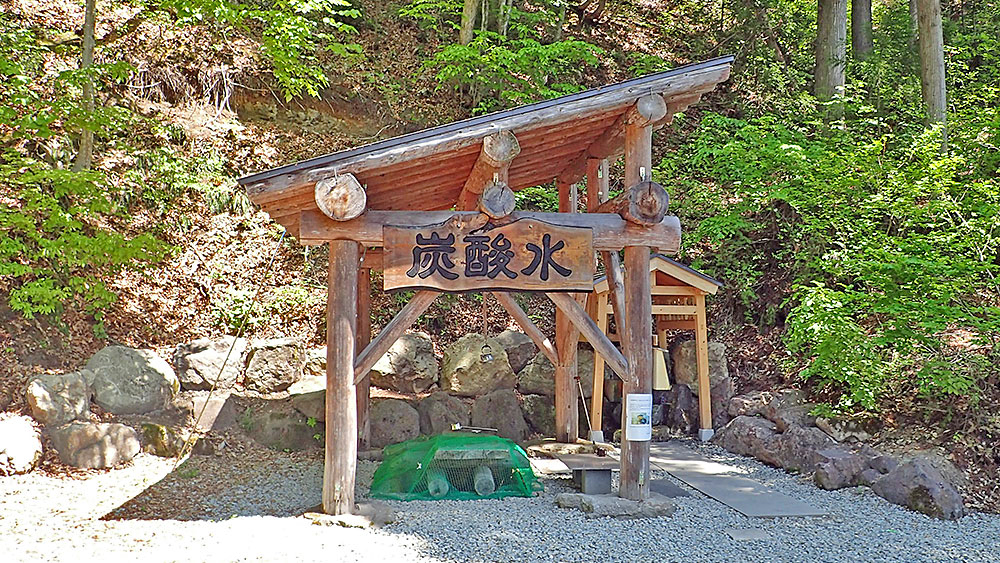
yTown & Gourmetz@ A well from which carbonated water springs forth. (Fukushima pref.)
As you can see in the picture, carbonated water really does gush out of this well!
My impression is, "The carbonation is just right!" The taste is normal and mild, and it seems like it would go well with highballs too. @(Nihedon @ KesaranPasaran Lab)
@
@
I'd like to explain this carbonated water well by delving into knowledge learned in middle and high school.
As is well known, when limestone formed on the seabed is sent deep into the Earth's atmosphere by tectonic plates and comes into contact with magma, it usually undergoes metamorphism, turning into marble.
However, if the limestone completely fuses with the magma, the main component of limestone, CaCO3, decomposes in the reaction CaCO3 ¨ CaO + CO2, releasing a large amount of CO2.
Then, if the magma containing the limestone continues to exist deep underground, the CO2 remains fused within the magma due to its pressure and temperature. However, as the magma rises, the pressure and temperature decrease, causing the CO2 to precipitate.
The general principle behind carbonated water wells seems to be that if there is groundwater nearby, CO2 dissolves into it, purifying the water into carbonated water.
However, since the Japanese archipelago is built along the Earth's tectonic plates, if the above reason alone were true, it seems like there should be much more "natural carbonated water" welling up. The reasons why this isn't the case are likely as follows:
(1) The reaction in which limestone is completely incorporated into magma is unlikely to occur.
(2) Magma that has completely incorporated limestone often remains stagnant deep underground.
Let me explain these reasons a little further.
Magma types are usually classified by their silicon dioxide content. The lower the silicon dioxide content, the higher the fluidity. In order of decreasing silicon dioxide content, they are called "basaltic magma," "andesitic magma," "dacitic magma," and "rhyolitic magma."
Andesitic magma is the dominant type of magma beneath Japan.
Therefore, Japanese magma has a moderate fluidity (neither completely fluid nor completely viscous), and it seems to have a short lifespan, not fully incorporating limestone (CaCO3).
Furthermore, due to the structure of near-faults around Japan, even if limestone formed on the seabed is pulled deep into the crust by plate tectonics, it is not pulled all the way to the deepest part where magma exists. Therefore, it is rare for it to be melted by magma; instead, metamorphism (where limestone turns into marble) due to contact with magma is more common.
Furthermore, even when limestone is completely melted by magma, the magma's viscosity is not low, so the frequency (velocity) of its ascent is small. Therefore, CO2 often remains trapped deep underground, incorporated into the magma.
This seems to be the reason why there aren't many wells in Japan that produce slightly carbonated water. I'd like to hear the opinions of someone more knowledgeable about this.
@
@
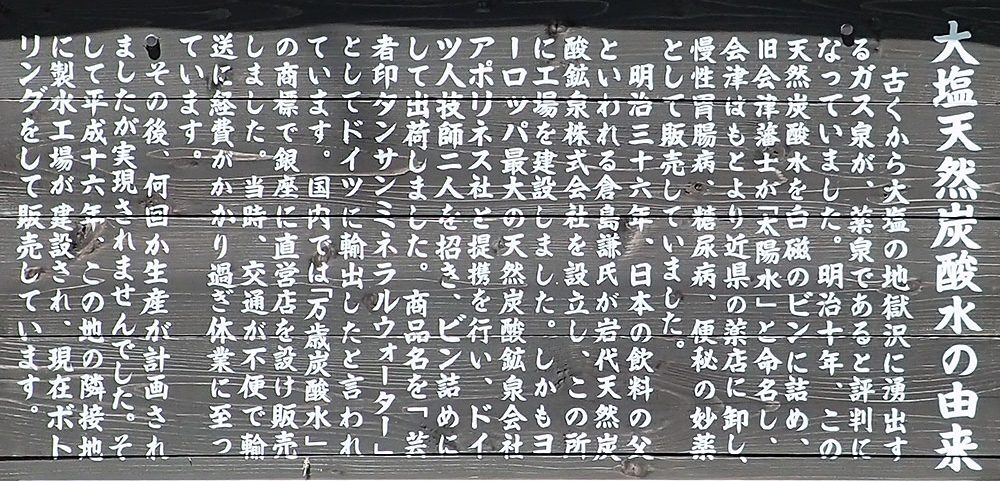
This "natural sparkling water" was named "Taiyo-sui" (Sun Water) and sold by a samurai of the Aizu domain during the Meiji era.
It was then exported overseas under the name "Geisha-jirushi Tansan Mineral Water" (Geisha Brand Sparkling Mineral Water).
*The "Geisha-jirushi" brand of sparkling water still exists today!
@
@
ACCESS :
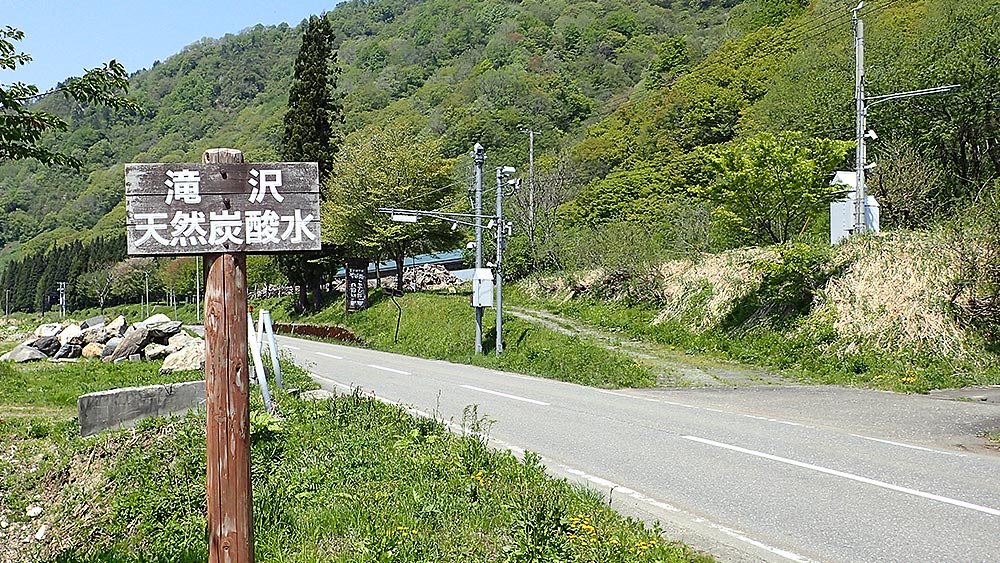
By car: Approximately 1 hour from Aizu-Bange Interchange on the Ban-etsu Expressway
By train & taxi: Approximately 20 minutes by taxi from Aizu-Kawaguchi Station on the JR Tadami Line
@
@